

If you have been around manufacturing, machining, or industrial production long enough, you’ve probably heard people talk about 5-axis machining as if it’s the gold standard. And honestly, in many cases, it is. As product designs become more detailed and industries demand tighter tolerances, traditional machining methods often struggle to keep up.
Today, manufacturers are no longer just cutting the basic shapes, but rather dealing with complex machining, intricate geometries, deep cavities, and the parts that must be accurate from every angle. This is exactly why multi-axis machining starts to matter.
In this guide, we will break down what a 5-axis CNC machine is, how it works, why it’s so valuable, the types of 5-axis CNC machines available today, and where it truly makes a difference. So without any further ado, let’s get right into it!
Simply put, it’s a CNC machine that can move the tool or part in five directions at once. Traditional machines work on three axes—X, Y, and Z—which is fine for basic parts but limiting for complex designs.
A 5-axis machining adds two rotation axes, allowing the tool to reach multiple angles in a single setup. What this does is reduce re-clamping, improve accuracy, and deliver smoother finishes. Below is all you need to know about the 5-axis in question:
Once you understand what is a 5-axis CNC machine, the next question that often comes up is: how many different types of 5-axis CNC machines are there? The short answer is: quite a few. And the way we classify them usually depends on how they move, how they’re built, and what they’re used for.
How the machine is built impacts how it moves and what kinds of parts it handles best.
After the mechanical setup, another way to divide 5-axis machines is by how their rotary axes are arranged in space.
The third way to think about types is by what the machine actually does and how it’s used day to day.
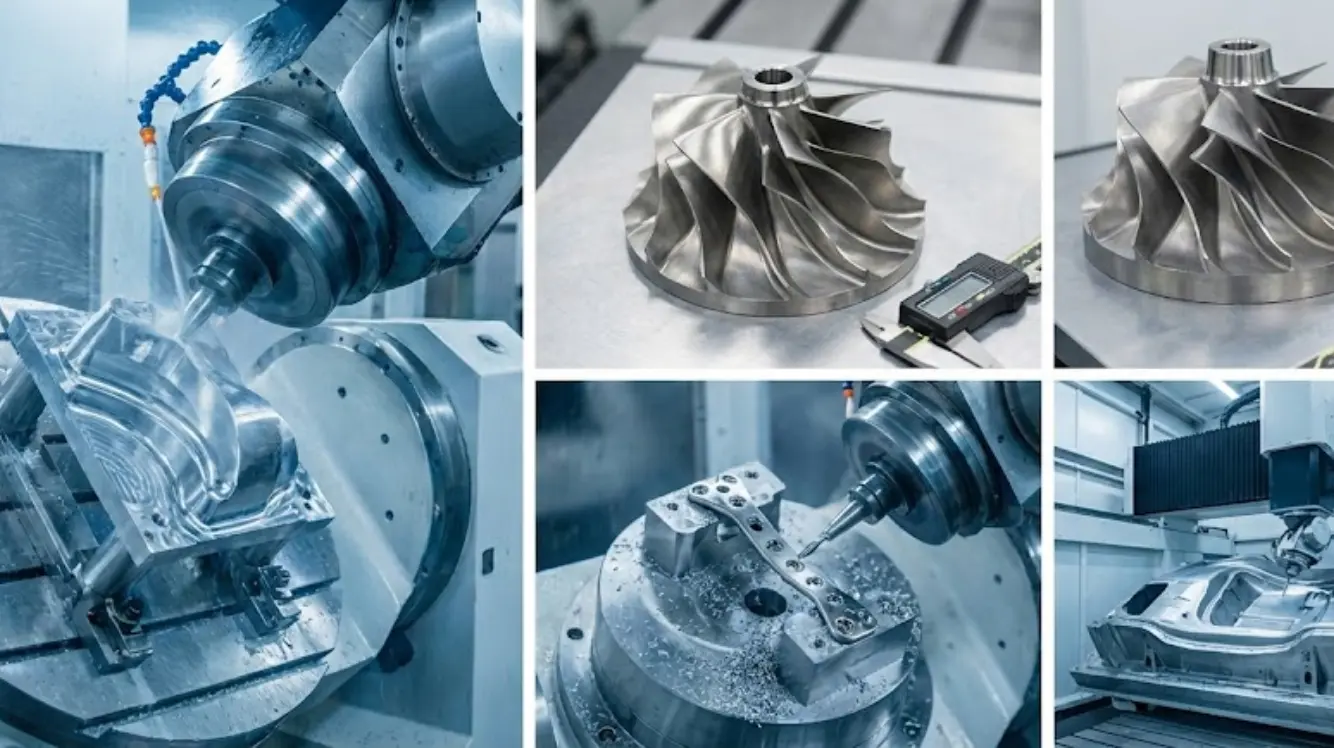
So why do manufacturers actually invest in this technology? It is certainly not because it looks impressive on paper, but because the benefits of 5-axis machining show up very clearly once production starts. It changes how parts are made on a day-to-day level:
Starting with one of the most noticeable benefits of 5-axis machining is how much it reduces the need for multiple setups. Basically, instead of stopping the machine, repositioning the part, and hoping everything lines up again, the tool can reach different faces in a single run. At FANUC, we value this consistency more than anything!
Parts designs are getting more complicated with each passing day. There are deep cavities, curved surfaces, compound angles, and these are pretty common, and some special cases. And with conventional setups, this becomes very impractical to perform on a regular basis. This is where you need complex machining, which is far more flexible!
Another benefit is the kind of finish you want, and the kind you get. The quality of production shows up on the surface. Here, because tools can stay at optimal angles throughout the cut, there is less vibration and more controlled material removal. The result? You get a smoother finish straight off the machine, instead of relying on secondary finishing operations.
Although 5-axis machines are technically pretty advanced, they simplify the overall process for you. What takes up the most energy is the time it takes to process. But now, with fewer steups, fewer interruptions, and fewer chances for mistakes add up to save time for you! This is one of the most practical benefits of 5-axis machining, especially in environments where deadlines matter.
Last but not least, tool wear is a cost that noone counts beforehand, but can be heavy later on. In any machining operation, you need better tool orientation and more consistent cutting conditions so that the stress on the tool can be reduced. This is the only way you can make the tool last longer and perform more predictably. When precision components are being produced repeatedly, even small improvements in tool life make a noticeable difference.
Also Read: How FANUC CNC Machine Interpolator Controls Enhance Multi-Axis Machining Accuracy
If you want to look at the usefulness of 5-axis machining, you will have to look at where it is actually being used on the shop floor. These applications truly show how some parts are hard to make, some have tight tolerances, and some, where mistakes have a huge cost. Let’s look at them:
Aerospace parts are rarely ever simple. You are basically dealing with curved surfaces, deep pockets, and angles that don’t line up neatly on a flat plane. In this space, complex machining becomes non-negotiable and cannot be treated for granted. Here, even a small deviation can lead to serious damage and safety issues. This is why, at FANUC, we depend on multi-axis machining to produce precision components that are accurate across every angle.
This is where speed and consistency go hand in hand. There are engine parts, transmission components, and structural elements that need to be produced fast, but without compromising accuracy! This is where the benefits of 5-axis machining comes handy as there are fewer setups, shorter cycle times, and better repeatability.
As you must have guessed, in medical manufacturing, there is little to no room for any error. There are implants and surgical tools that demand fine details, smooth contours, and tight dimensional limits. And well, 5-axis machining allows these parts to be produced in a single, controlled setup, which will give a desired finish. Basically, for medical-grade precision components, a level of control is much needed, and you get that with CNC!
Components used in energy and power systems are often exposed to high pressure, heat, and continuous stress. We are talking about turbines, valves, and similar parts, which usually involve intricate geometries that are difficult to machine using conventional methods. This is one of the areas where “what is a 5-axis CNC machine” stops being a theoretical question and becomes a practical solution.
By this point, it's easier to see why 5-axis machining has quietly become a standard in serious manufacturing setups. It is clearly not about adding two more movements just for the sake of it, but rather being able to machine a part the way it was actually designed.
So when someone asks “what isa 4-axis machine,” the answer is quite simple: it’s a machine built for the kind of work that modern production demands. Another thing is that complex machining is not an alien concept now. It's pretty common, and so is the need to produce precision components that are accurate!
Once you understand what are the axes on a 5-axis machine, things start to make sense. Now add to that the different types of 5-axis CNC machines, and you will see why manufacturers can choose systems that match their exact workload, instead of just forcing designs to fit the machine.
However, the real benefits of a 5-axis machine will show up over time. Fewer setups, better surface quality, tighter tolerances, and less manual intervention. Whether a shop is trying to increase output or simply reduce errors, multi-axis machining gives more control over the entire process.
No. 5-axis machining is most valuable for parts with complex geometries, multiple angles, or tight tolerances. Simple components with flat surfaces can often be produced efficiently using 3-axis or 4-axis machines. The decision depends on part complexity, accuracy requirements, and production volume.
3-axis machines move in X, Y, and Z directions, while 4-axis adds one rotational movement. A 5-axis CNC machine adds two rotational axes, allowing the tool to approach the part from nearly any angle in a single setup. This results in fewer setups, better accuracy, and improved surface finish.
Yes, in many cases. Although 5-axis machines have a higher initial cost, they often reduce overall production expenses by cutting down setup time, minimizing errors, improving tool life, and reducing the need for secondary finishing operations.
Industries that require high precision and complex part designs benefit the most. These include aerospace, automotive, medical devices, energy and power generation, and advanced manufacturing sectors where accuracy, repeatability, and surface quality are critical.
5-axis machining does require more advanced programming skills and operator training compared to 3-axis machines. However, modern CNC controls, simulation software, and automation features make it much more manageable and efficient once properly set up.
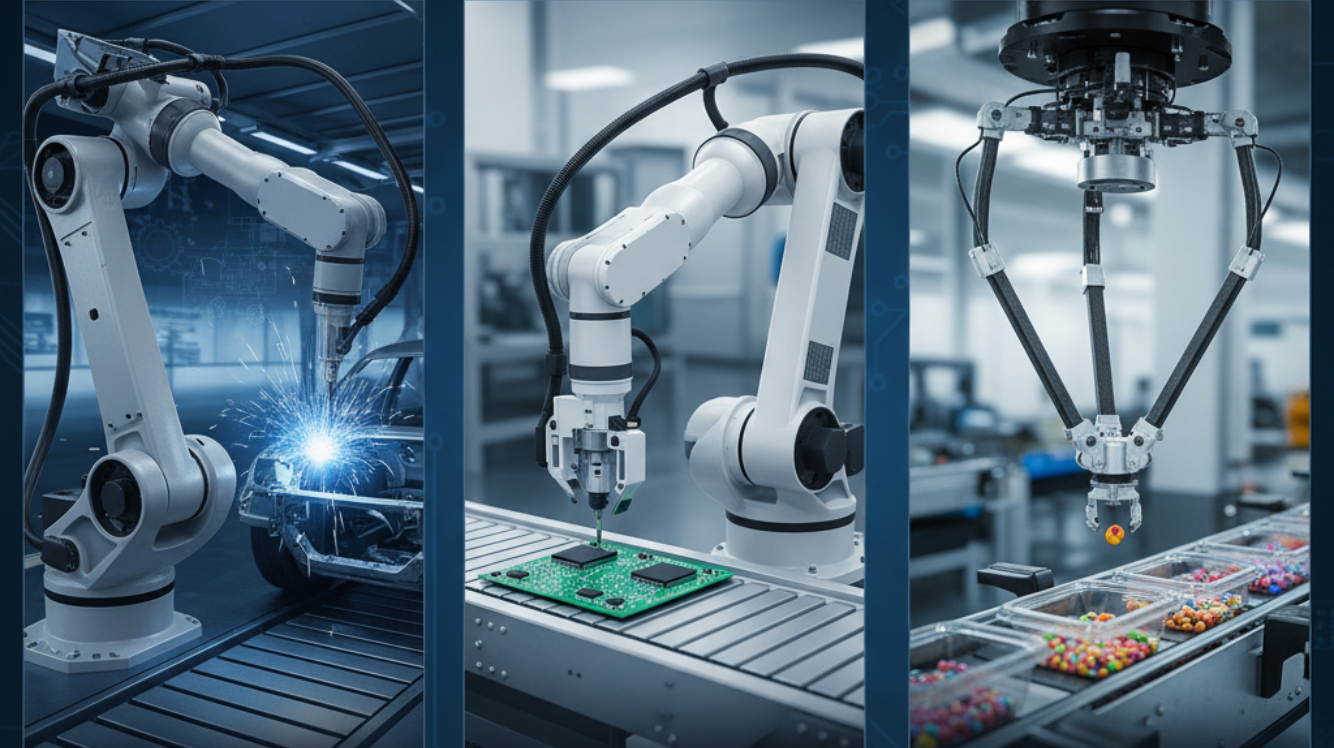
Discover various types of robotic arms used in industries like automotive, electronics, and packaging. Compare articulated, SCARA, delta, and cobot designs.
Know More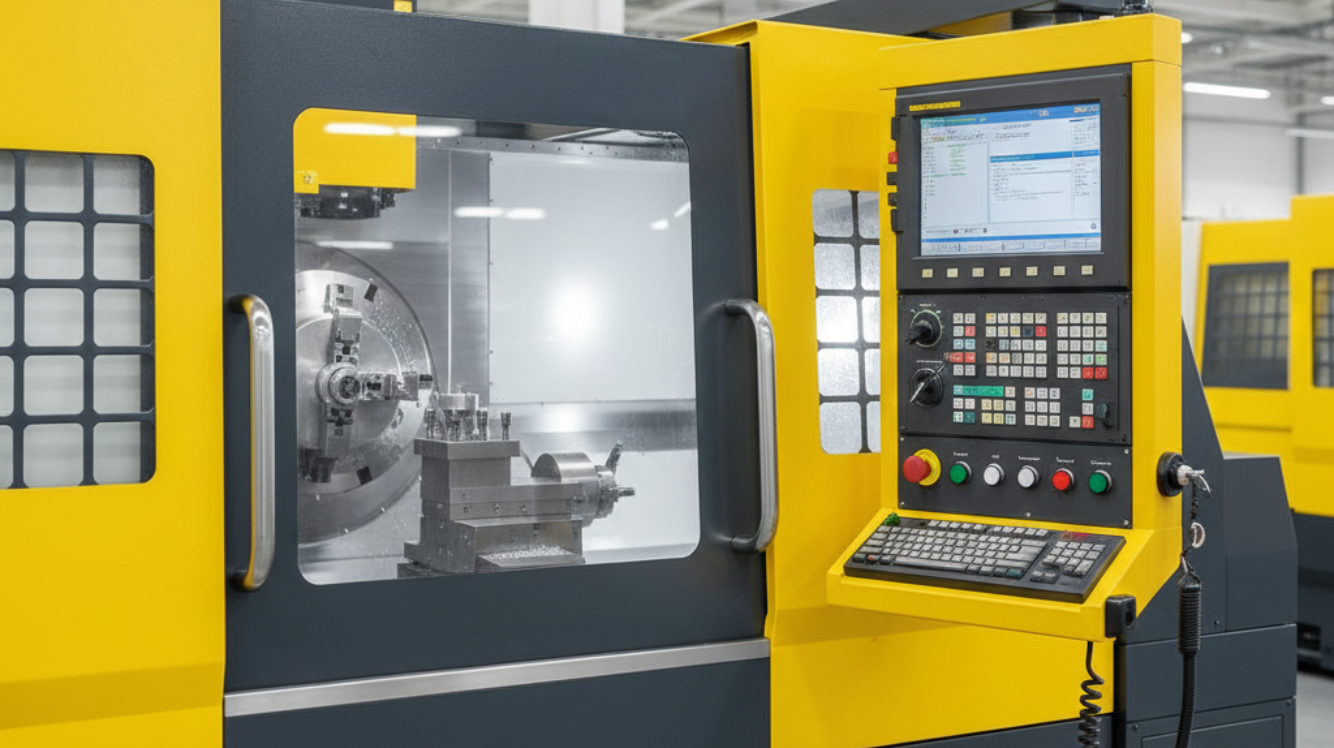
Understand the CNC and VMC machine difference, their functions, applications, and which one suits your machining needs. A clear and simple comparison.
Know More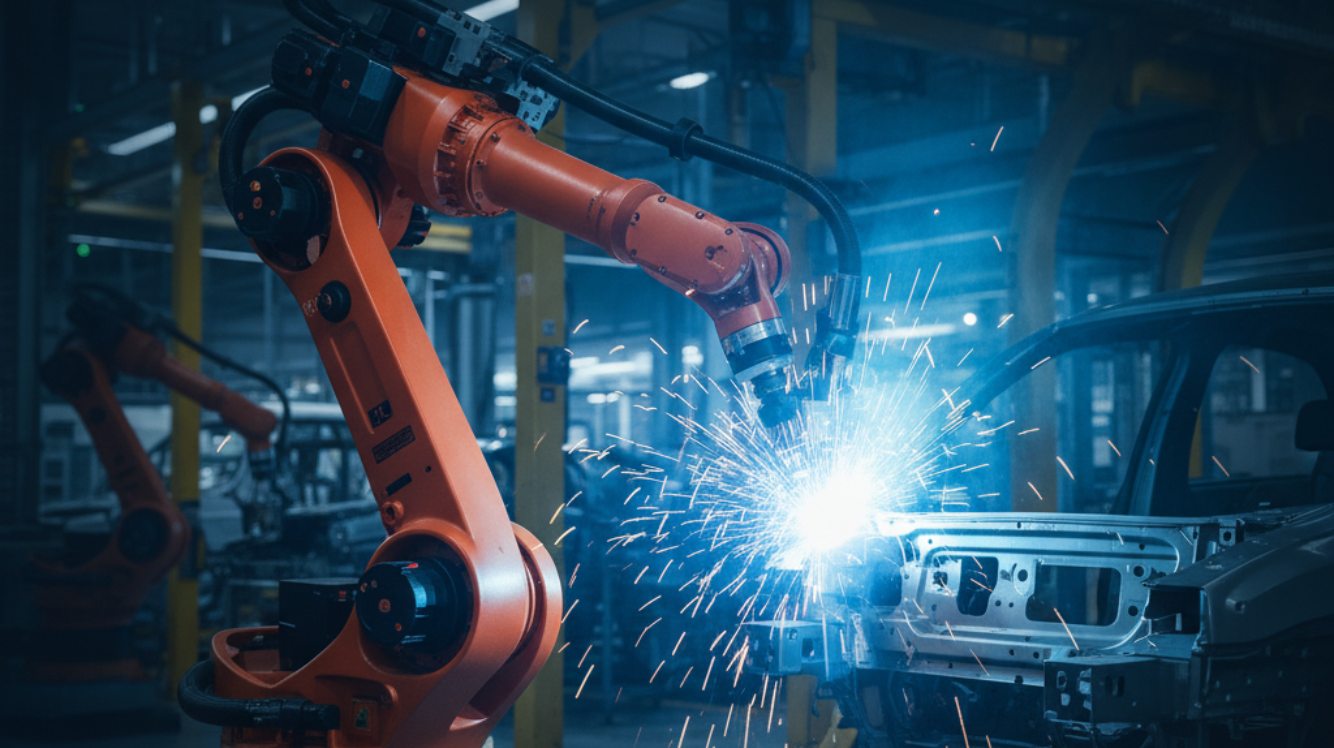
Understand the main types of industrial robots — articulated, SCARA, delta, and cobots. Learn their applications, advantages, and impact on modern manufacturing
Know More
.avif)


