
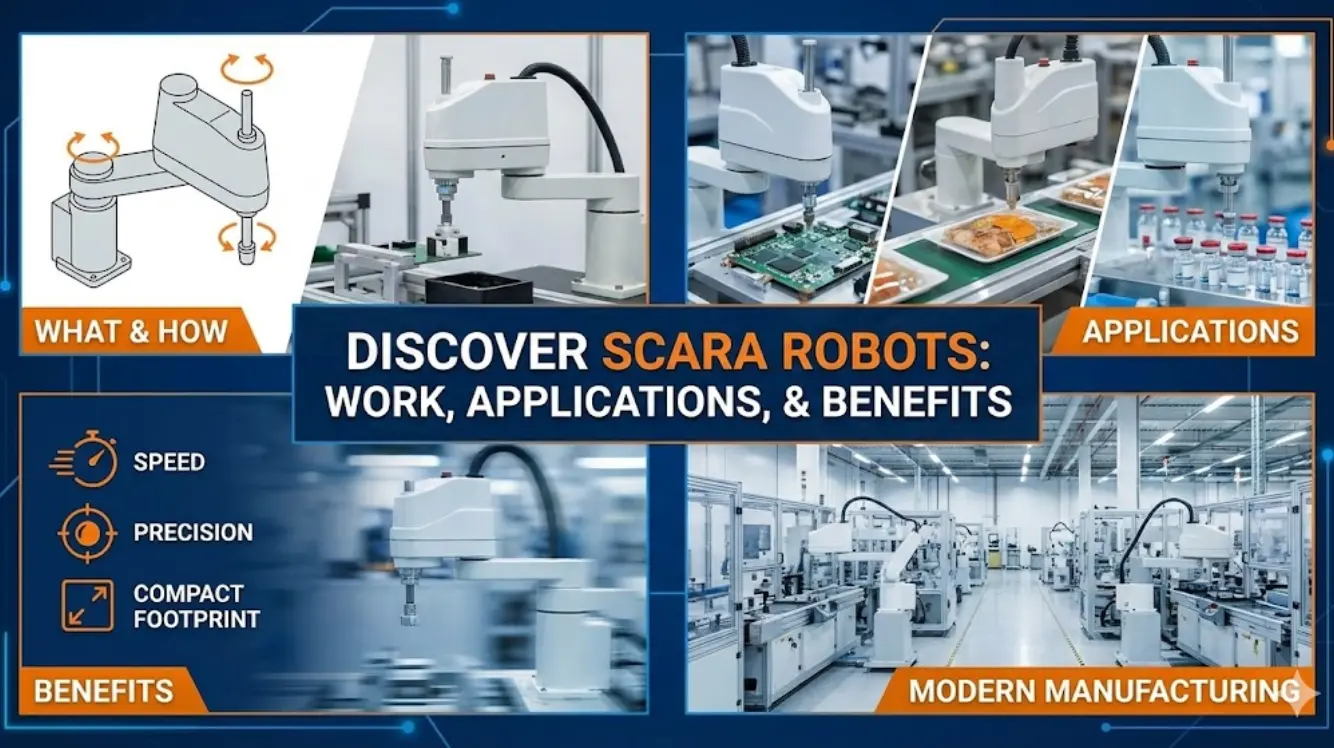
Modern manufacturing runs on systems that are fast, predictable, and accurate every single time. That’s why some of the most valuable robots on the shop floor aren’t the biggest ones, but the ones that do the same job flawlessly, thousands of times a day. This is where SCARA robots come into the picture.
If you are trying to understand what is a SCARA robot, the simplest way to understand is that it's a robot that is specially for speed and precision in a controlled workspace.
These robots are designed to move quickly in a horizontal plane while maintaining rigid vertical accuracy.
This makes them ideal for repetitive industrial tasks where consistency matters the most. In this article, we will take a look at what is SCARA robot, how the SCARA robot arm works, and why solutions like the FANUC SCARA robot are commonly chosen for high-volume industrial environments.
Let’s start with the basics!
A SCARA robot stands for Selective Compliance Assembly Robot Arm.
It is a robot that is designed to be flexible where speed is needed and rigid where precision matters the most.
It can move quickly side to side, but stays firm and stable when it moves vertically.
This balance is what allows it to perform assembly and placement tasks accurately. This happens without having to deal with unnecessary vibration or loss of control.
Here, the structure of the SCARA robot arm actually plays a big role in how efficiently it works! Most of the SCARA robots are built with four axes:
This is what allows the SCARA robot arm to move quickly without losing or compromising the accuracy.
The whole motion is smooth, repeatable, and most importantly, predictable.
This is what you need if you work in a high-volume manufacturing environment.
This is also the reason why SCARA robots are so common in places where speed and consistency are key.
Talking of key features, there is no single feature that sets these robots apart. Here is all you need to know about it:
And just like that, when reliability and long-term performance are a priority, many manufacturers like you look towards SCARA FANUC solutions.
A FANUC SCARA robot is designed specifically for demanding industrial environments where downtime is never an option.
Because of this, our systems are used in places where you need continuous operation, consistent accuracy, and smooth coordination with other automation equipment.
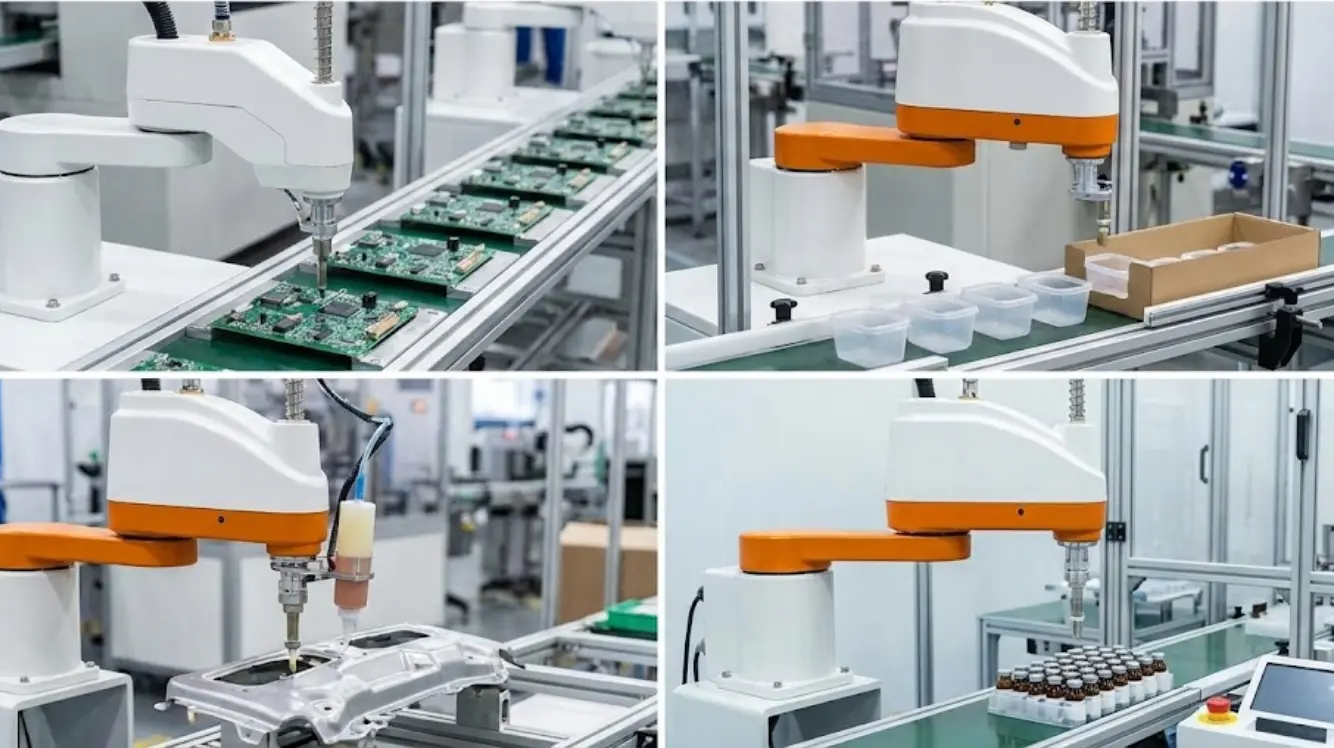
Because of their speed and accuracy, SCARA robot applications span multiple industries. Any task that requires fast, repeatable motion in a controlled workspace is a strong candidate:
Now let’s talk about why companies continue to invest in SCARA technology:
One of the biggest reasons why SCARA robots are so widespread is the speed. These robots are built to move quickly, but not at the cost of quality and precision. We know how even a small delay can impact the output, and these robots give you a steady rhythm that is fast, controlled, and consistent. And this balance can actually be tricky to achieve with many other robot types.
When people ask what is a SCARA robot best known for, repeatability is almost always the answer. If you go with a well-programmed SCARA robot arm, then it can perform the same task thousands of times with minimal variation. That level of consistency is especially important in places where even small errors can lead to quality issues, rework, or downtime.
Another practical advantage of SCARA robots is their compact footprint. Unlike a larger robotic arm that needs a clearance, this one can be integrated with your existing production line without any major layout changes. This is actually one big reason why SCARA robot applications are so effective in space-constrained environments!
If you look at it from a cost perspective, SCARA robots are great if you want something long-term. They have a simpler mechanical design, which means fewer components, lower energy consumption, and easier maintenance compared to complex robotic systems. Over time, you will notice how your operating costs will drop, and there will be less downtime for repairs!
Another benefit that often gets overlooked when discussing what are SCARA robots is how approachable they are from an integration standpoint. Hear us out! When you program this robot arm, it's actually more simpler, especially for tasks with repetitive motion patterns. So you save setup time and make it easier for teams to adapt without extensive retraining.
So, what are SCARA robots, really?
Well, they can be your workers who are fast, reliable, and efficient. The real value of SCARA robot applications lies in how seamlessly they fit into production environments. Whether it is electronics assembly, packaging, or automotive components, SCARA robot arms continue to expand as industries demand higher speed and better consistency.
If you are a company that is looking for dependable automation, then solutions like the FANUC SCARA robot can offer you a path forward. Without SCARA FANUC systems, you can get speed, accuracy, and reliability all in one place!
SCARA robots are best for high-speed, repetitive tasks that require consistent accuracy in a controlled workspace. Common examples include pick-and-place operations, assembly, fastening, press-fitting, PCB handling, packaging, and material transfer between workstations.
Unlike articulated or 6-axis robots, SCARA robots are optimized for fast horizontal movement with rigid vertical precision. This makes them faster and more efficient for assembly and placement tasks, while also being more compact and easier to integrate into existing production lines.
Yes. One of the biggest advantages of SCARA robots is their compact footprint. They can be installed in tight spaces without major layout changes, which makes them ideal for factories where floor space is limited.
SCARA robots are known for very high repeatability. Once programmed, they can perform the same task thousands of times with minimal variation, making them ideal for industries where consistency and precision are critical.
No. SCARA robots are generally easier to program and maintain compared to more complex robotic systems. Their simpler mechanical design results in lower maintenance requirements, reduced downtime, and lower overall operating costs over the long term.
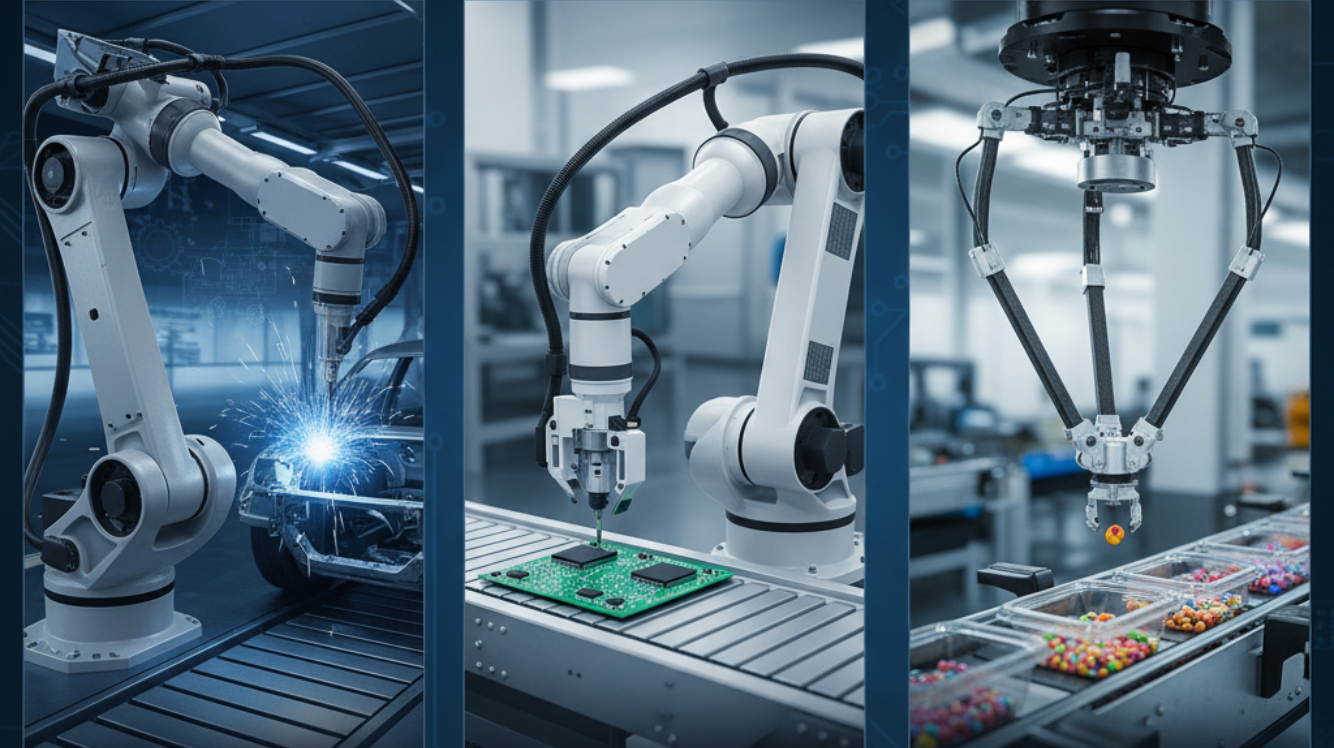
Discover various types of robotic arms used in industries like automotive, electronics, and packaging. Compare articulated, SCARA, delta, and cobot designs.
Know More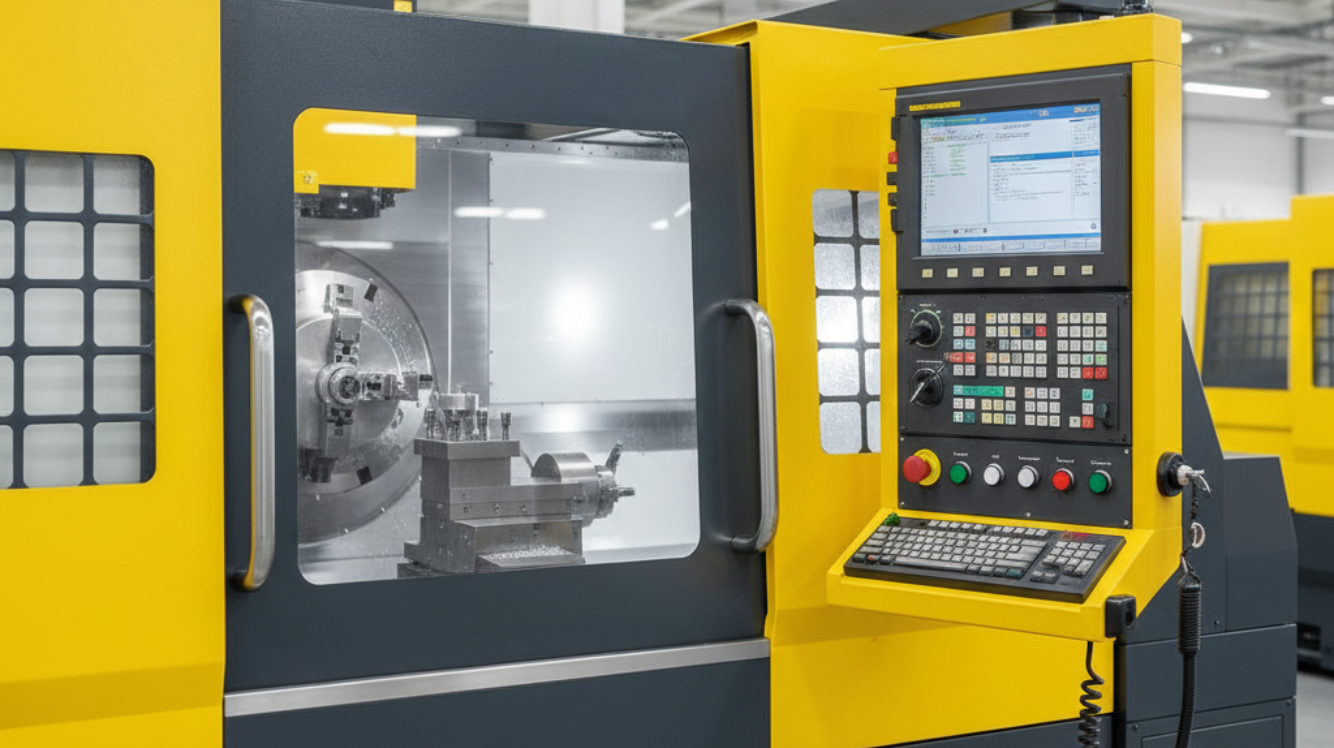
Understand the CNC and VMC machine difference, their functions, applications, and which one suits your machining needs. A clear and simple comparison.
Know More
Understand the main types of industrial robots — articulated, SCARA, delta, and cobots. Learn their applications, advantages, and impact on modern manufacturing
Know More
.avif)


