
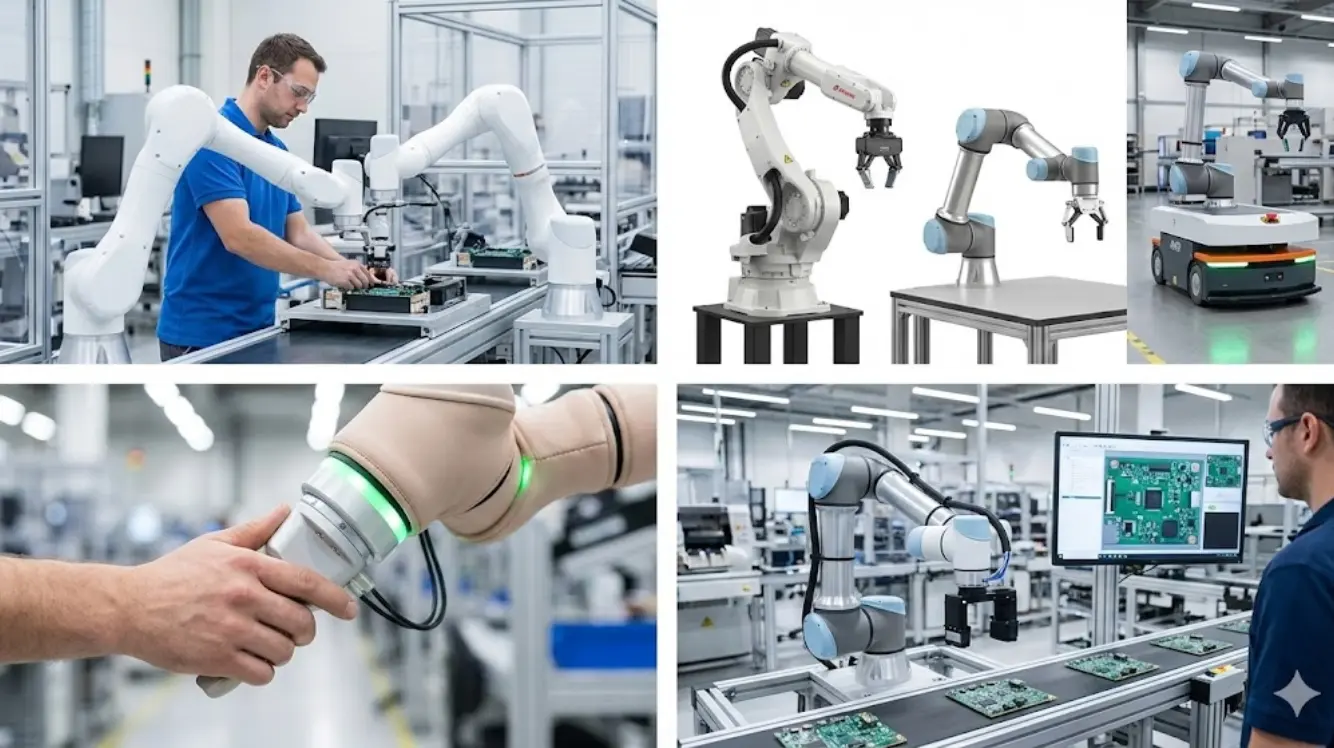
Automation is not new to manufacturing. What is new, however, is how closely humans and machines are starting to work together.
For a long time, robots lived behind the safety cages, where they are separated from the people. Humans stayed on one side, while the machine stayed on the other. That setup is slowly changing, thanks to collaborative robots.
Manufacturers today are looking for automation that fits into real production environments where people still play an important role, and flexibility matters as much as speed. This is where cobots come into the picture.
If you’ve been hearing the term cobots more often and wondering what are cobots, how they actually work on the shop floor, and why so many industries are moving in this direction, you’re not alone.
In this guide, we will explain what are cobots, how they differ from traditional industrial robots, the different types of collaborative robots, and their applications. Let’s begin!
So first things first, what are cobots?
Collaborative robots, or as we call them, cobots, are the robots that are designed to work alongside humans, and not behind barriers or inside cages. Unlike traditional industrial robots that need to be physically separated from the safety reasons, cobots can work in the same space as you.
Their primary role is to assist, support, and take over repetitive or physically demanding tasks. But no, they don't replace humans.
If we look at it in a more practical sense, cobots robots are designed with safety in mind. They run on controlled speeds, come with come with built-in force, and are capable of stopping automatically if and when needed.
So basically, by design itself, they make human robot collaboration something that can actually happen in real life. When people ask what cobots are, the simplest way to explain them is that they are robots that adapt to human work.
In modern production environments, cobots in manufacturing are commonly used for tasks like part handling, machine loading and unloading, inspection, and repetitive assembly steps. And while a cobot handles consistency and repetition, human workers focus on decision-making, problem-solving, and quality.
Here are the key differences you should know about:
With that, you know the difference between a robot and a cobot. It's actually pretty simple that traditional robots are great with speed and volume, and cobots excel at adaptability and safety. So when comparing cobot vs robot, it's not about which one is better but rather what fits your production needs.
Starting with the most commonly used type of collaborative robot, these cobots are made so that the amount of force they apply stays the same. So if the robots come into contact with a person, it reacts immediately to reduce impact or stop movement altogether.
Clearly, they are well-suited for close human robot collaboration. They are used in assembly, inspection, and light handling the atssk where people and robots can work side by side.
Hand-guided cobots focus on simplicity and ease of use. So instead of complex programming, operators can actually physically move the robot arm to show it exactly what to do. The cobot is smart enough to then record these movements and repeat them during operations.
These cobots are designed to constantly monitor the space around them. They use sensors and adjust their speed based on how close a person is. And when a human moves closer, the robots slow down, but if the distance becomes too small, it stops completely. This is another great example of how types of cobots are tailored to real factory conditions.
With safety-rated monitored stop cobots, the robot operates normally until a human enters its defined workspace. At that point, the robot comes to a controlled stop and only resumes once the area is clear again. This setup is usually used where full-time collaboration is not needed, but human access is necessary.
Also Read: 5 Types of Robotic Arms and Their Industrial Applications
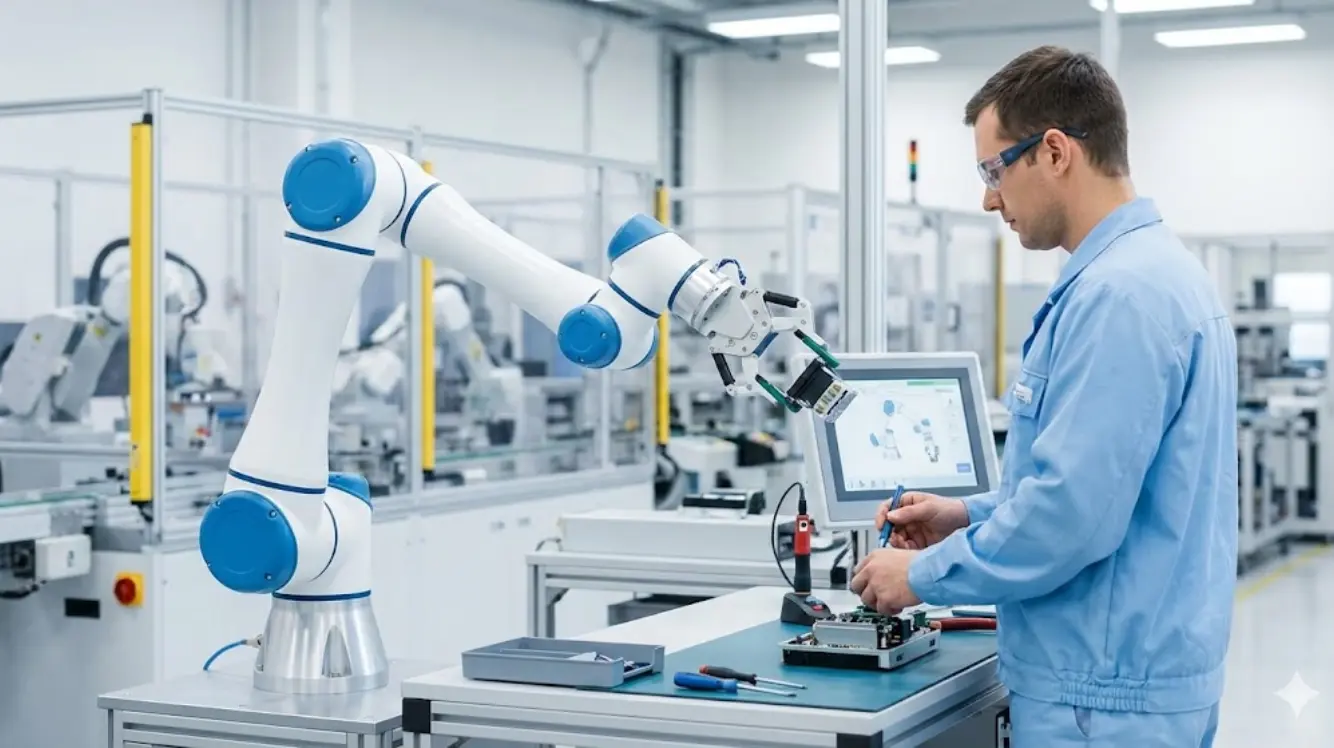
This is one of the most common areas for cobots in manufacturing. They can assist with screwdiing, component placement, and light assembly tasks where you need consistency more than anything!
Cobots can load and unload CNC machines, injection molding machines, and presses. This is what improves machine utilization while reducing operator fatigue for good.
As they are equipped with vision systems, cobots perform repetitive inspection tasks that too with high accuracy. This will give you the consistent quality that you need.
Cobots handle packing, labeling, and palletizing tasks, especially in environments where product sizes or packaging formats change frequently.
The gentle and precise movements of cobots make them suitable for electronics assembly, testing, and handling delicate components.
Also Read: Different Types of Industrial Robots and Their Uses in Industry
Understanding what cobots are is no longer something manufacturers can afford to ignore. You know how the shop floors are changing, production demands are shifting, and the old “one robot, one cage” setup doesn’t always make sense anymore.
This is where collaborative robots bring a more practical way forward. It's a way where automation supports people instead of replacing them, and efficiency does not come at the cost of flexibility.
Once you can identify the difference between a robot and a cobot, things start to fall into place. Traditional robots are built for speed and isolation, while cobots are for shared spaces and adaptability.
Now that you know the different types of collaborative robots, you can also choose solutions that fit your processes rather than htan forcing production to adjust the machine.
So it would be safe to say that cobots in manufacturing will become less of an innovation and more of a standard in the near future.
Yes. Cobots are specifically designed for human–robot collaboration. They come with built-in safety features like force and torque sensors, speed control, and automatic stop functions. If a cobot detects unexpected contact with a person, it immediately slows down or stops to reduce the risk of injury.
The main difference lies in how they operate around people. Traditional industrial robots usually require safety cages and operate at very high speeds, while cobots are designed to share the same workspace as humans. Cobots focus on flexibility, ease of programming, and safe interaction rather than just speed and volume.
No. One of the biggest advantages of cobots is their ease of use. Many cobots can be programmed through simple interfaces or even by hand-guiding the robot arm. This makes them accessible to operators without advanced robotics or coding experience.
Cobots are not meant to replace humans. Instead, they support workers by taking over repetitive, physically demanding, or monotonous tasks. This allows human workers to focus on decision-making, quality control, and more value-driven activities.
Cobots are widely used in manufacturing, assembly, machine tending, inspection, packaging, electronics, and precision industries. They are especially useful in environments that require flexibility, frequent changeovers, or close collaboration between humans and machines.
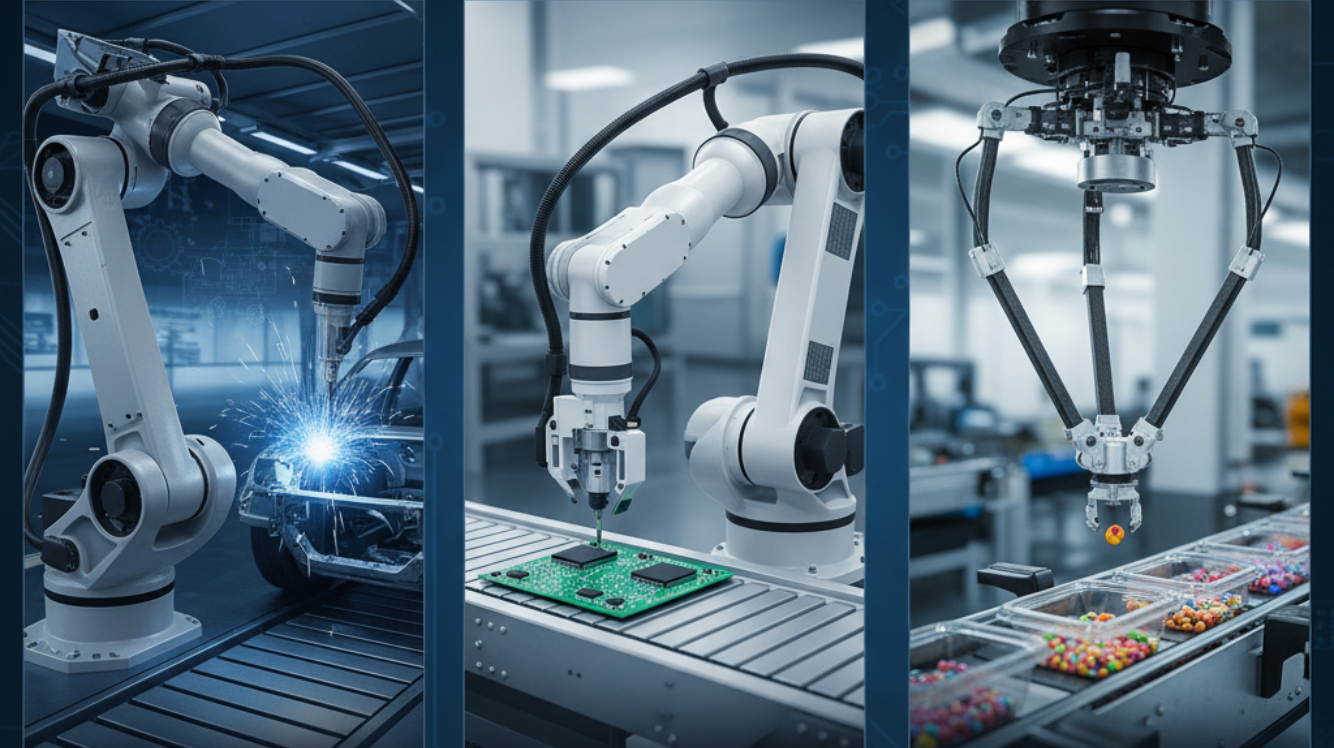
Discover various types of robotic arms used in industries like automotive, electronics, and packaging. Compare articulated, SCARA, delta, and cobot designs.
Know More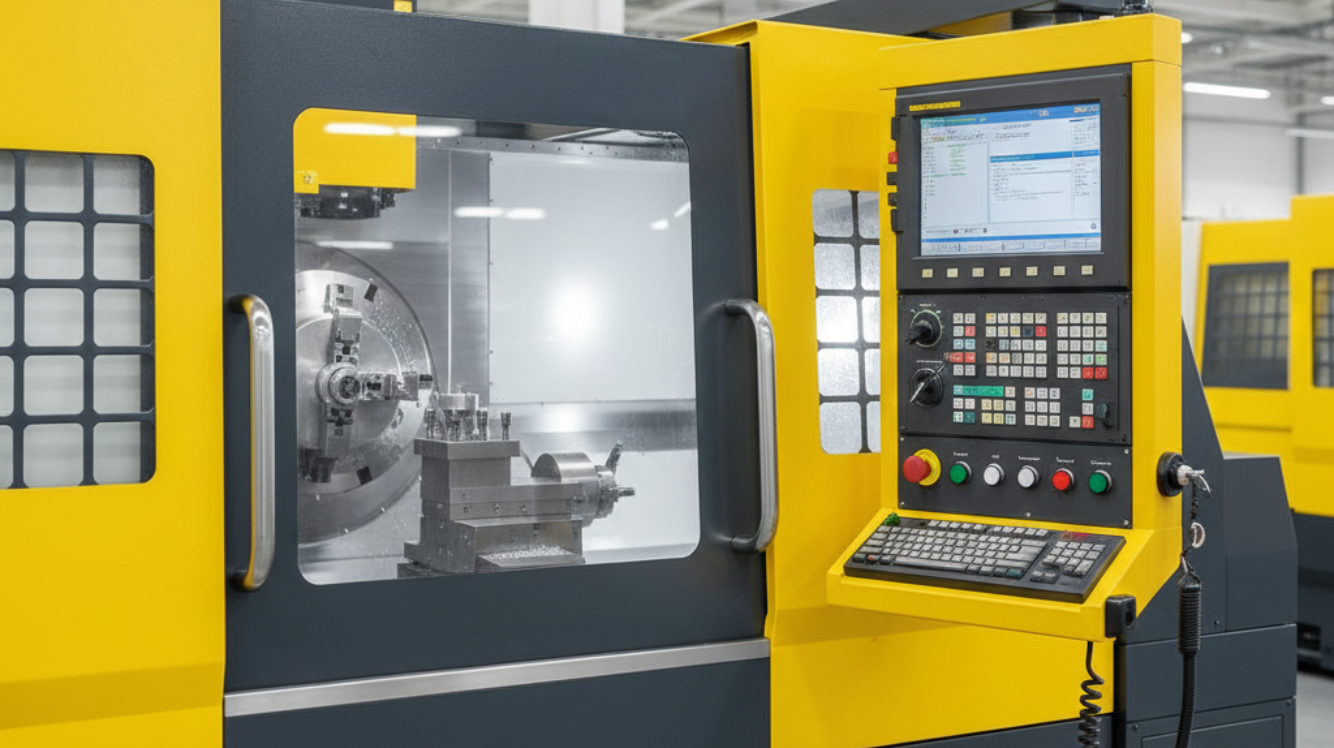
Understand the CNC and VMC machine difference, their functions, applications, and which one suits your machining needs. A clear and simple comparison.
Know More
Understand the main types of industrial robots — articulated, SCARA, delta, and cobots. Learn their applications, advantages, and impact on modern manufacturing
Know More
.avif)


