
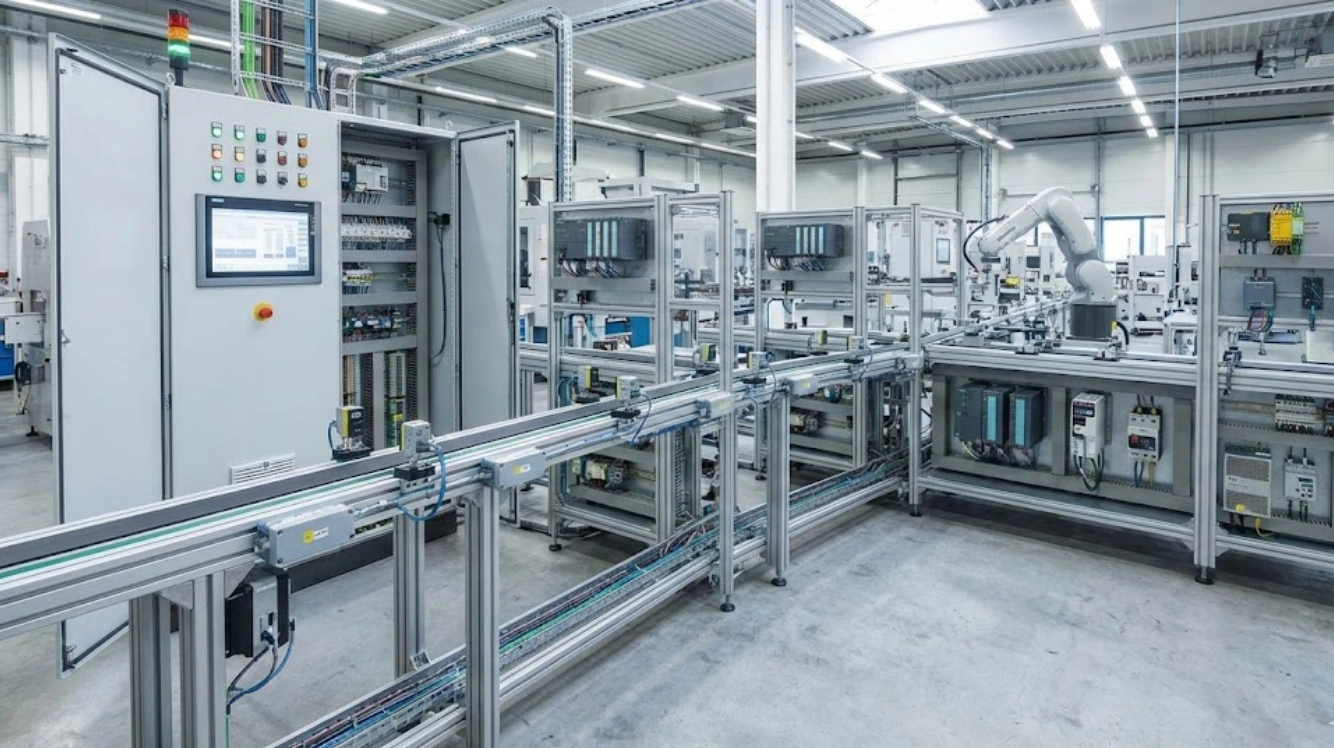
Manufacturing today looks nothing like it did a decade ago. And that change is largely driven by industrial automation control systems. From precision machining and robotics to real-time monitoring and predictive maintenance, modern factories rely on tightly integrated automation and control systems to stay competitive.
At FANUC India, we work closely across automotive, electronics, aerospace, medical devices, and general engineering. One thing that stays consistent is that businesses want to invest in the right industrial automation and control infrastructure if their goal is to gain productivity, better quality, and long-term operational stability.
In this article, we break down the core components of industrial automation control systems and explain to you how a control automation system works in a real manufacturing environment! So without any further ado, let’s get right into it!
If you want to know how modern factories get work done so accurately, safely, and on scale, you need to know about Industrial automation and control. It literally uses intelligent systems that are made up of hardware, software, and communication networks to run machines and processes with minimal manual effort. All this, while still maintaining tight control over quality and performance!
At a basic level, industrial automation bascilaly tales over repetitive, time-consuming tasks that are prone to human error. But automation and control go beyond just making machines move. It ensures that those machines operate exactly as intended, while adapting to changes, responding to real-time conditions, and maintaining consistency shift after shift!
So, in a well-designed control system in automation, the system is constantly at work behind the scenes. And all this happens continuously, often in literally milliseconds, without disrupting the production. That balance between speed and precision is exactly why industrial automation control systems form the foundation of smart manufacturing!
Quick Insight: Industrial automation and control are what allow modern factories to run fast without losing accuracy. Automation handles repetitive work, while control systems continuously monitor conditions and make real-time adjustments so machines perform consistently, safely, and exactly as intended—often in milliseconds.
These are basically the brains of a control automation system that processes the inputs from sensors and sends commands to actuators. The role here is logic control and real-time decision making. Due to this feature, this component comes in handy with assembly lines, packaging, and CNC cells. With this, we ensure that industrial automation and control run smoothly.
Sensors act as the eyes and ears of a control system in automation, providing real-time data for decision-making. They constantly feed information back: temperature, pressure, position, speed, so the system can react instead of blindly following commands. The types include:
Actuators are what actually do the work. They turn commands into movement. When a controller says “move,” actuators are what make that happen. Whether it’s a motor turning, a piston pushing, or a tool moving into position. FANUC designs actuators to work tightly with our CNCs and robots, so motion stays smooth, controlled, and predictable.
HMIs are what people interact with. They’re the screens operators use to see what’s going on, change settings, and respond to alarms. A good HMI shows what matters, when it matters.
So if done right, here are the benefits you get:
And if it is done poorly, it will slow everyone down.
SCADA and DCS come into play when operations get bigger and more complex. SCADA systems are what allow teams to monitor and control operations from a central location, even if it has to be across multiple machines or lines.
This is what ties everything together. Control and programming software defines how machines behave, how they respond to changes, and how issues are diagnosed. It’s where logic, motion, and safety all meet, and then the software is used for:
But here is a thing: In larger or faster systems, relying on one central controller isn’t always practical. Distributed controllers place control logic closer to the machines themselves. This means there will be reduced delays, and communication loads will be manageable. For example, each robot can have its own controller, but still, all of them can be in sync with the main system.
This is the CPU. where all decisions are processed. Basically, it handles the incoming data, runs logic, and sends commands back out, over and over again. And when it comes to high-speed manufacturing, this has to happen in real time, as delays of even milliseconds can matter!
Contrary to popular belief, safety isn’t something added at the end, but rather it’s built into control automation systems from the start. When we talk about safety systems, they include emergency stops, light curtains, interlocks, and safety PLCs. And their job is simple: protect people and equipment when something goes wrong.
10. Communication Networks & Protocols
Last but not least, none of this works if components cannot talk to each other. So, communication networks are what connect sensors, controllers, HMIs, robots, and SCADA into one functioning industrial automation control system. At FANUC, we offer a seamless connection between CNCs, robots, HMIs, and monitoring systems ensure that everything stays in sync.
Talking of communication and everything being connected, let’s talk about how these control automation systems actually work together, and what the typical control flow looks like:
Step 1: Sensors collect real-time data
Step 2: Controller processes logic
Step 3: Actuators perform actions
Step 4: Feedback returns to the controller
This loop repeats thousands of times per second. In advanced industrial automation control systems, this loop is enhanced with:
Quick Tip for Manufacturers: When designing a new industrial automation control system, start with sensors and controllers. Everything else, like actuators, HMIs, and networks, works more efficiently when data and logic are reliable.
Today, manufacturing is not just about running machines faster. It's about knowing that your processes will behave the same way tomorrow, next month, and years down the line. And that reliability comes from how well industrial control systems are planned, connected, and looked after.
At FANUC India, we see this every day on the shop floor. When industrial automation and control are done right, operations don’t just move more quickly but actually become calmer. So whether you’re improving an existing production line or setting up a new facility from scratch, choosing the right automation and control systems isn’t just a technical upgrade. It’s a long-term business decision that affects productivity, quality, and peace of mind.
1. What are the main components of an industrial automation system?
An industrial automation system typically includes sensors, controllers (like PLCs or CNCs), actuators, HMIs, communication networks, software, and safety systems.
2. What are the 7 parts of a PLC?
The main parts of a PLC are the power supply, CPU, input modules, output modules, memory, communication modules, and the programming interface.
3. What is the difference between DCS and DDC?
DCS is used for large, complex industrial processes with distributed control, while DDC is usually applied to smaller, localized systems like HVAC or building automation.
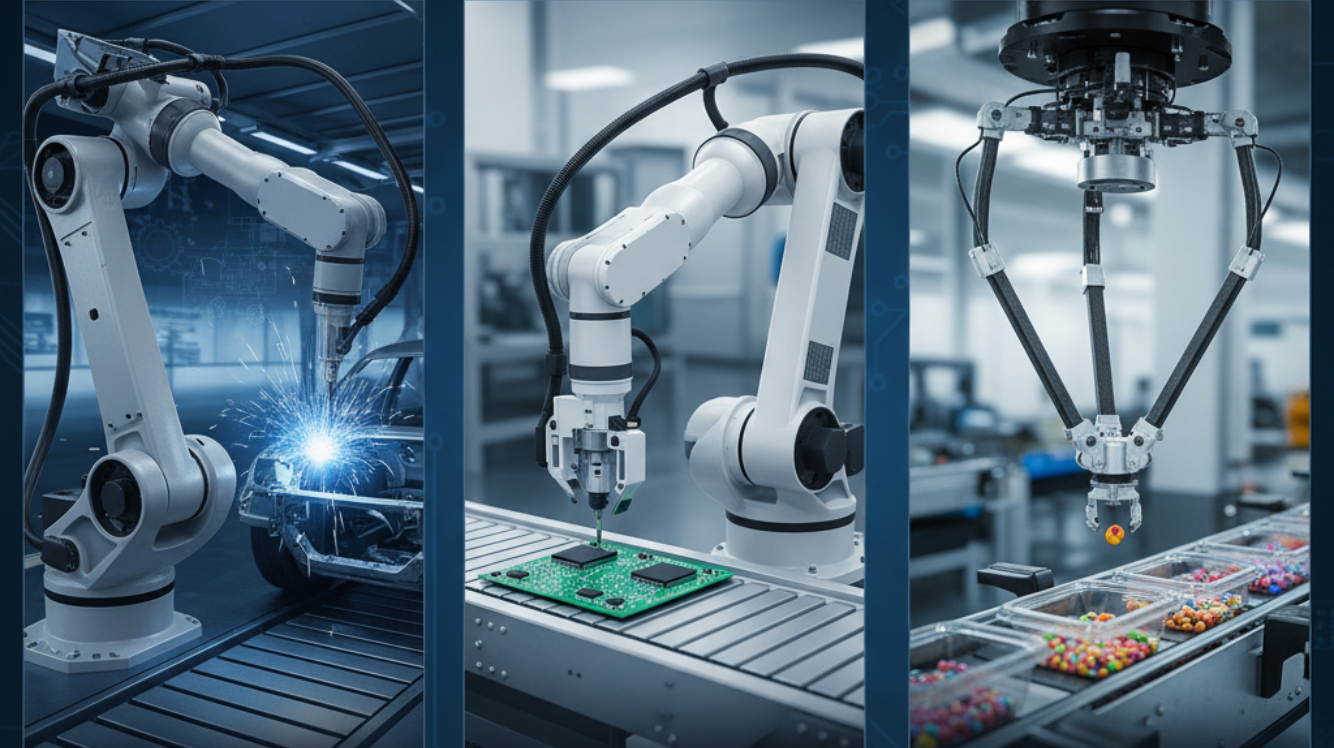
Discover various types of robotic arms used in industries like automotive, electronics, and packaging. Compare articulated, SCARA, delta, and cobot designs.
Know More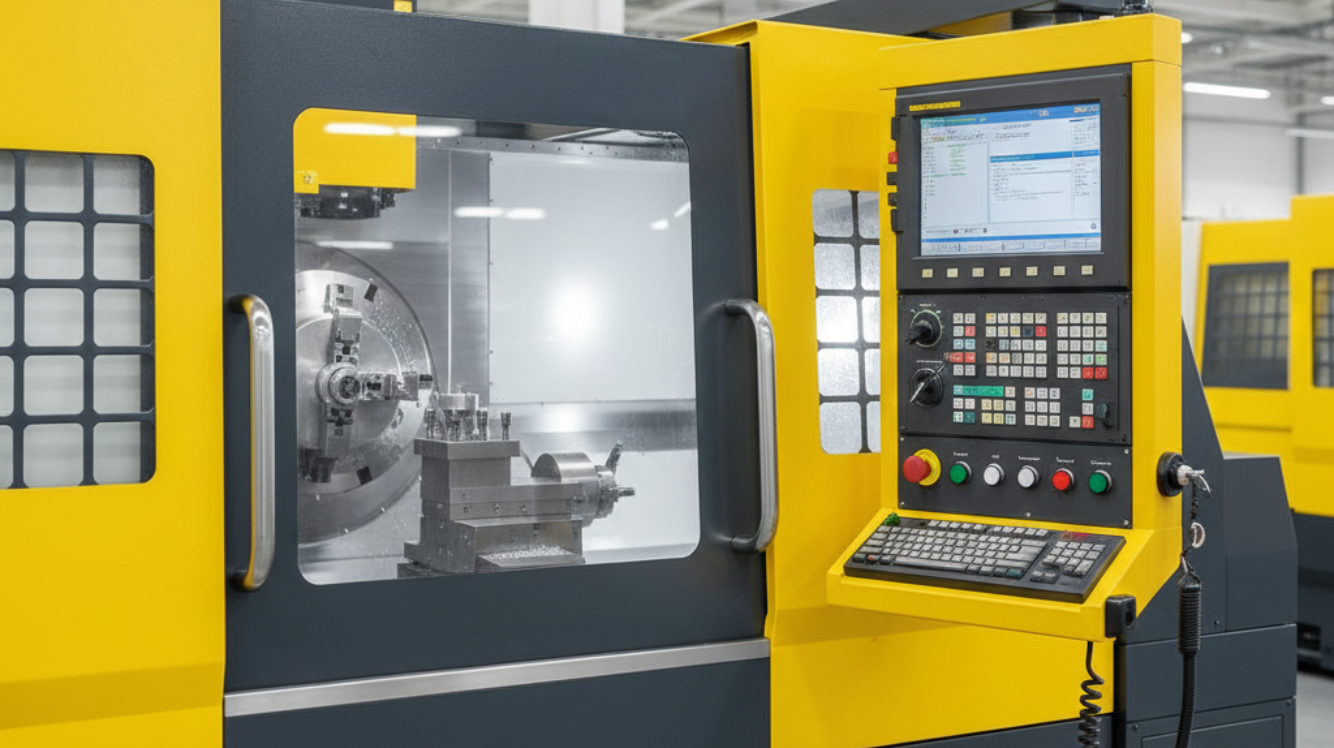
Understand the CNC and VMC machine difference, their functions, applications, and which one suits your machining needs. A clear and simple comparison.
Know More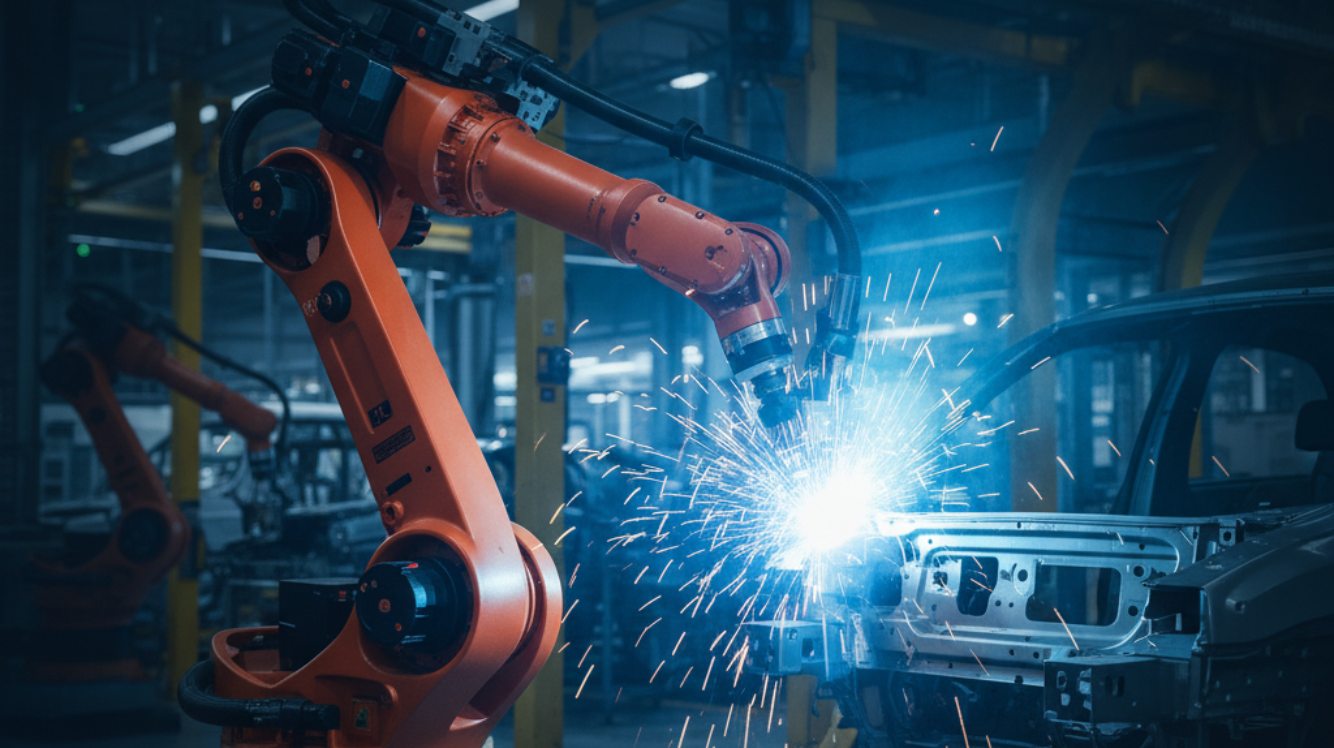
Understand the main types of industrial robots — articulated, SCARA, delta, and cobots. Learn their applications, advantages, and impact on modern manufacturing
Know More
.avif)


